Being Comfortable with Discomfort

While reading an Education Week Blog by Jill Berkowicz and Ann Myers, The Importance of Challenging Our Comfort Zone   (August 6),  I was reminded of the need for school leaders, instructional coaches and teachers to create environments where staffs and students are comfortable with discomfort.

Berkowicz and Meyers explore the need for school leaders to be aware of their own blind spots by listening to the perspective of others to uncover hidden assumptions affecting current decision making. (discomfort)

“When bringing about change don’t we tend to bring a team together of like minds and expect that support will grow from there? But how often do we include our most ardent adversaries, doubters, and skeptics? They have a place at the table from the beginning, in our earliest planning. Welcomed into the process, they can expose our blind spots, question our hidden assumptions, and challenge sacred cows.”

I had the chance to work this past week with the New Jersey Education Association’s (NJEA) Priority Schools Initiative. Implementation teams from selected schools with a high need and strong desire to increase student achievement success gathered for two days of learning, examining and challenging current practices, and planning for change. This included central office staff, principals, association staff, local association leaders, and teachers. The program, in its second year, requires some conversations that create discomfort at times for everyone. The design of the program including retired teachers serving as coaches (funded by NJEA) to the implementation teams and in the school with staff creates an environment encouraging people to be comfortable with the discomfort needed for change.

When providing training for coaches I use this diagram from Tom Gordon to illustrate the need for coaches to create an environment where teachers are comfortable with discomfort. [Note: I’ve added the level of Unconsciously Talented not in Gordon’s work. I use this phrase to describe when a teacher is successful and doesn’t know why.]

 aug 18a


Teacher growth occurs (change occurs) at the conscious levels. The work of coaches moves teachers to consciousness or keeps them conscious as they practice a strategy which generally is uncomfortable for the teacher.

Moving from Unconsciously Unskilled to Consciously Unskilled requires a teacher to discover what they don’t know or can’t do. (Discomfort)

Anytime we are working at the Consciously Skilled level, purposely practicing, there is a discomfort. We often feel clumsy at this point.

The two conscious spots are where growth and change occur. Coaches create discomfort. To be successful they also need an environment where the teacher is comfortable with discomfort. If not, the teacher withdraws from the change process.

 I would suggest that a major role of Professional Learning Communities is to create discomfort and comfort. When teams of teachers examine student work, data and assessment results, I suggest they look for something that brings them discomfort. Once we find discomfort with the current results, it’s on to creating a plan for getting the changes we want. Most often that means teachers changing what they are doing. (discomfort).  Facilitating a PLC means helping create an environment for being comfortable with discomfort.

When I work with teachers to identify student behaviors that they want to develop in order to increase student achievement, perseverance is most often on the list. They want students to struggle longer, start over, make another attempt. That means they need students who work through the discomfort of not being successful in their initial attempts at learning or problem solving. The teacher needs to create a classroom climate where the students are comfortable with discomfort.  Effective cooperative groups often help with that environment.

 As this new school year begins consider what you will consciously do to create an environment for leaders, teachers and students that promotes comfort with discomfort.


Which Model of Coaching Is The Right Choice?

This past week I was asked this question in two different settings. A possible future client was interviewing me on a phone call to explore “the fit” for me to be a trainer/coach for administrators and teacher leaders who would work in coaching roles to increase student success by increasing teachers’ skills. I was told that the district had held cognitive coaching training and he wanted to know if my model might contradict the previous training. (Arthur Costa and Robert Garmston created Cognitive Coaching in 1984.)

Later in the week in a district where I have been consulting and providing coaching training for over a year, a central office administrator said that some people had requested clarity on what was “our model of coaching.”

In the first case, I responded to the interviewer that in my training for coaching I focused on exploring the complexity of teaching and learning and the verbal skills of coaching. I was comfortable that someone taking a strong cognitive approach to their coaching would find much in the training to be applicable. At the same time I was offering skills that might allow a change in the coach’s approach when they weren’t feeling successful. He responded that was interesting as some administrators and coaches were raising concerns about their effectiveness.
I approach many models on a continuum rather than one or the other.
Technical____________________Cognitive
At the far left the coach provides specific, sometimes corrective feedback on a skill the teacher has chosen to focus upon. (I just completed a day of media training and was coached on answering reporters’ questions…highly technical feedback on the strategies in the training which I was consciously practicing.)
At the far right the coach uses mostly questions and specific observed data that the teacher has requested…. little or maybe no approval from the coach or suggestions from the coach. (At lunch after the training the media consultant’s coaching became much more cognitive having staff explore our thinking about what might be best strategies for us.)
In the second case I presented the principals and coaches with several coaching scenarios which were present in the training they have had and the practices the district had implemented. In addition to the technical—–cognitive continuum we explored:
Supervisors___Instructional Coaches____Mentors____Peers
(All of these positions are being asked to take on increasing coaching roles.)
Expert______________________Eyes, Ears, Skin
(Sometimes a teacher wants a coach with expertise: someone who can tell and show me how to do it. Other times a teacher wants someone who records what is happening and lets her figure out the meaning and direction.)
The purpose of coaching could be technical, collegial, or challenge.(Garmston; How Administrators Support Peer Coaching) Explored in an earlier blog…
Consider technical coaching most commonly connected to staff development. This is the follow up coaching that is needed when teachers take new skills back to the classroom to integrate into their existing practice. We are all familiar with how our best intentions to implement new learning can be lost without coaching support, reinforcement and celebrations of persistence.
I connect collegial coaching to the development of teacher relationships. In other words, what we are coaching may be less critical than the fact that staff are getting to know each other and our programs through peer observation and conversation and establishing a reflective coaching culture within the team and school.
Peer coaching in Switzerland
Challenge Coaching is helpful when teachers want to work together to create a new opportunity or solve a problem. Grade level or department teachers can use challenge coaching to tackle a standard that is troubling a number of students or create a plan for a disruptive student that they share….observing in each other’s classrooms and reflecting and problem solving. (A natural extension of PLCs)
Peer coaching in Maryland
Coaching is a culture….. a process we use to accomplish important things.
How about a non-model of coaching? How about the coach being skilled to detect the type of coaching being sought by the teacher and respectfully delivering? As coaches’ skills grow they can often assist the teacher in identifying what type of coaching is most likely to support the teacher growth need to support student achievement.


Advisors and Mentors: Using Open Questions and Confirmatory Paraphrases

I have been working with the principal, Charlie McDaniel, of the new East Ridge Middle School (ERMS) in Lake County, FL. The administrative and guidance leadership of the school worked to create an advisory program for the 6th,7th,and8th grades students coming to this brand new school. Students will stay in the same advisory group through their three years but will have a different advisory teacher at each grade. These teachers will form an advisory unit working together during the three years focusing on each student’s needs. One guidance counselor will stay with the students through their three years.

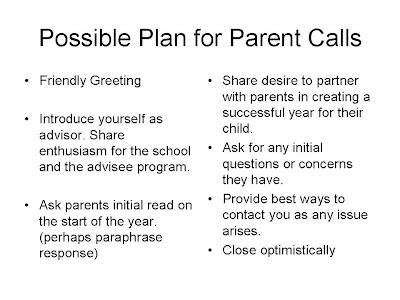
I was asked to create a workshop to assist teachers in their advising role and to explore advisors’ communications with parents as the school year started. I decided to focus on open ended questions and paraphrases as verbal skills that used consciously would increase teachers “knowing” their students.

I defined opened ended questions as those where the answer to the question drives the direction of the conversation and closed questions as those were the question controls the direction of the conversations. We identified purposes for open and closed question in classrooms. This activity pointed that the purpose of the advisories would often require an open environment.

Teachers then practiced forming open questions identifying students’ past school experiences and future plans, and questions for initial calls to parents.

Here are some examples I shared:
• Describe a project you did last year that you spent a lot of effort on….Why did you put in effort?

• What would you look for when picking a future job? Why?

• What was your impression after our orientation program?

• As your daughter’s advisor, what do you think is important for me know?

•What are your expectations of a middle school program?

•If you were selecting teachers for your son, what would you look for in the teacher? Why?

We then explore how confirmatory paraphrases could be used to extend responses that you might receive from the open ended questions:

Student: I put a lot of effort into an English project where my best friend and I wrote a story and illustrated it as a book for 1st graders. We got to read it to the kids and they really liked it.

Possible teacher paraphrases:
* You enjoyed working hard with your friend.
* Sounds like you are skilled in writing.
* When the kids enjoyed it, the hard work was worth it.
* You were proud of your work

Parent: I’d pick a stern, caring teacher for my son. He can talk his way out of work if you let him.

Possible teacher paraphrases:
• Your son has the gift of gab.
• Sounds like you have a charmer.
• You want the sternness to come from caring.
• You want your son to put effort into learning

Teachers were provided with the following cue card to prepare for their initial call to each advisee’s home:

Several days after this workshop for middle school teachers, I was in Gainesville, FL (Alachua County Schools) facilitating a session with coaches and mentors for beginning teachers. I was asked for suggestions on how to hold the initial conversation of introduction with beginning teachers. I pulled up the above examples from the advisor workshop to practice open questions and paraphrases. Then we discovered that with a little tweaking the plan for parent calls could be transformed into initial conversations with beginning teachers.
Take a moment and try it!


Mentoring and Student Achievement

I recently spent an afternoon with the mentor teachers at St Mary’s County Public Schools in Maryland. Prior to my presentation Jeff Maher, the director of professional development, reviewed the results of a recent survey of beginning teachers regarding the time, type of activities, and quality of mentoring they were receiving. Jeff celebrated the results which showed increased positive finding across the past few years. I sent Jeff a few questions to understand the investment and commitment the system had made to the mentor program. Here is the information Jeff sent back……

St. Mary’s County Public Schools (SMCPS) is located in St. Mary’s County Maryland about 100 miles south of Washington, D.C. on the western peninsula in Southern Maryland. SMCPS serves approximately 17,000 students and 1,500 certificated staff; 94.2% of which are highly qualified. Generally we hire between 150 & 175 new teachers each year.

Our school system is large enough to offer a wide variety of academic programs and services, and small enough to maintain an atmosphere of friendliness, helpfulness, and personalized service. As a school system, we are focused on student achievement and assuring that our students meet rigorous standards; at SMCPS all children can and will learn. In fact our mission statement says it all:

“Know the learner and the learning, expecting excellence in both. Accept no excuses, educating ALL with rigor, relevance, respect, and positive relationships.”

Mentoring in SMCPS involves experienced teachers paired with novice teachers, providing coaching, support, and guidance as the new teachers transition in their first two years. Mentoring is a key component of our long-range Teacher Induction Program.
Our induction program includes:
New Teacher Orientation:
· Day 1 & 2 – Optional Content Sessions
· Days 3-5 Required Professional Development on content, curriculum, classroom management, and system orientation. One-half day is devoted to demonstration classroom visits with monthly follow-up sessions.
· Electronic Learning Community forum
· Peer mentors are provided release time for peer coaching.
Induction Support includes:
· For 1st year teachers – Monthly New Teacher Seminars, Weekly Teaching Tips via email, Financial Seminar, New Teacher Socials and Annual Spring Re-Energizer with mentors
· For 2nd year teachers – Classroom Management that Works! course
· 3rd year – collegial partners

We request that all mentors are trained. Twice a year we offer a 1-credit course entitled Skills for Coaching and Mentoring. This course is based on the Performance Learning Systems’ course: Conferencing Skills for Mentors & Coaches and Steve Barkley’s book Quality Teaching in a Culture of Coaching.
Throughout the course, participants:
· Develop effective coaching and communication skills to build rapport among colleagues, create positive instructional change, and enhanced self-esteem for new teachers.
· Learn a prescriptive process for communicating with a colleague in a pre and post classroom observation.
· While observing instruction, become skilled at the use of several data collection instruments.

We attribute our positive results to the adage: Communicate, communicate and communicate. Weekly, new teachers, along with their mentors, receive a Teaching Tip via email. Mentors receive a monthly newsletter, The Mentor News.

Contact information: Jeff Maher, jamaher@smcps.org


The Needs of Beginning Teachers and How Mentors Respond

I was recently stranded overnight and then delayed while traveling to Rochester, NY to conduct a two day training for Mentors. I called my colleague, Sandra Fink, who lives close by and requested that she step in to cover until I could arrive. When I arrived, I found that Sandra had the group deeply engaged in a discussion around applying William Glasser’s elements of motivation to beginning teachers and mentors. I asked Sandra to share her activity here with you.

Sandra writes:
The Rochester City School District’s Career in Teaching Program (CIT), a collaborative effort of the district and Rochester Teachers Association, has been a positive catalyst for over twenty-three years. It has been successful in improving teacher retention and providing a professional ladder for effective lead teachers to advance and remain in the classroom. Steve Barkley has been a consultant since the program’s inception and continues to facilitate coaching workshops during new mentor orientation. Marie Costanza, the current director, was one of the original mentors who credits her success with mentoring new teachers to developing effective coaching skills.

DIRECTIONS: Let’s look at mentoring beyond survival. Work in small groups and list the characteristics, activities and behaviors of the mentor and intern in the motivation stage you have been assigned.

In the third edition of The Quality School: Managing Students Without Coercion (1998) William Glasser, M.D., identifies five universals that motivate people:

• Survival – learning the ropes, doing the right things when approaching
something new.

• Belonging – being accepted, receiving approval, be liked by the group.

• Power – feeling comfortable enough to experiment and take risks, knowing
what to do, having a sense of power.

• Freedom – feeling confident to explore, taking ownership, and the freedom to
make choices.

• Fun – confident, excited, motivation spreads to others.

We had a whole group discussion about the survival stage. It was very apparent that everyone had a good idea of what survival sounds like, looks like and feels like to the beginning teacher.

Then, each table was assigned one of the remaining steps; belonging, power, freedom or fun. Here is what Rochester mentors generated when applying to mentors and the beginning teachers they serve.

BELONGING
Characteristics
• mentor and intern – being accepted, being respected, common knowledge

Activities
• mentor – assisting in set up, inviting, introducing to colleagues
• intern – observing

Behaviors
• mentor – calling to check up, sharing resources, socializing
• intern – open minded, calling for help

POWER
I can do it, confidence and competence,
The mentor moves from “how do I do this” to “here’s an idea… how can you use this?” The intern takes chances, and is looking forward not backward.
A synthesis of what you learned becomes what you know,” I am an asset, I got it!”

FREEDOM
The intern becomes a risk taker, creative, adventurous, intuitive, open to new ideas, reflective thinker, fearless… They embrace many ideas, growing, seeking freedom and values, accepting failure, searching for strategies to motivate others.. a trail blazer.
The intern, feeling in control, adjust + readjust = flexibility, trust, confidence from success. The mentor finds satisfaction in seeing the intern move to a true professional level.

FUN
Mentor and intern are finding….
Pizzazz, sharing, laughter, friendship, survival, power, anticipation, excitement, freedom, field trips, being yourself, celebrations, belonging, cooperative learning, encouragement, sunshine, warm fuzzies, positive communication, and collaboration.

What would your mentors and beginning teachers say………..?