Podcast: Assessment in an Inquiry Focused Classroom

Assessment in an Inquiry Focused Classroom

Trevor MacKenzie, the author of “Inquiry Mindset Assessment Edition,” describes the incongruity that can exist in some classrooms between co-designed inquiry learning activities and teacher-controlled assessment activities. How do we move to teacher/student co-designed assessments that build “assessment capable learners?” Trevor provides some thoughts to guide coaching to teachers who are exploring assessment. 

Connect with Trevor and find his resources and books here.

Subscribe to the Steve Barkley Ponders Out Loud podcast on iTunes or visit BarkleyPD.com to find new episodes!

PODCAST TRANSCRIPT

Steve [Intro]: 00:00 Hello, and welcome to the Steve Barkley, ponders out loud podcast. Instructional coaches and leaders create the environment that supports teachers to continually imagine, grow and achieve. They model an excitement for learning that teachers in turn model for students. This podcast is dedicated to promoting the important aspects of instructional leadership. Thanks for listening. I’m thrilled you’re here.

Steve : 00:33 Assessment in an inquiry focused classroom. Our guest today is Trevor MacKenzie, an experienced teacher, author keynote speaker, and inquiry consultant, who has worked in schools throughout Australia, Asia, North America, South Africa, and Europe supporting educators in implementing inquiry based learning practices. In his book, “Inquiry Mindset Assessment Edition,” Trevor examines the role of assessment in education through the lens of co-designing and co-constructing with students. He supports teachers to scaffold towards an assessment reality that is infused with student voice understanding and autonomy. When I read those words on his site, I knew I had to get him on here to talk to us. So I’m anxious to have him share his insights and possibilities with us. So welcome Trevor.

Trevor: 01:38 Thank you, Steve. And to be honest, that’s the book I’m most proud of. I’ve got three babies, but that’s the one that I hold up near and dear to my practice. It’s the one, actually, Steve, if you can imagine, I finally said things that I’ve always been wanting to say. I finally shed light on areas that I’ve always wanted to shed light on. And so to be able to talk about some of these structures, the book, for sure, but you know what it looks like in practice with schools that I support around the world, it’s it’s exciting. So thanks for hosting me, Steve.

Steve : 02:04 You bet. I’m wondering if you’d share how you became interested in an inquiry approach to teaching and learning.

Trevor: 02:10 Well, that’s a great question. I became more interested because my students demanded it of me, essentially. When I started my career, I realized that I was entering my practice with a lot of bias, a lot of baggage, a lot of understanding what I thought teaching and learning should look like nd I was realizing that I was missing the mark. And noticing how my students were responding and just being kind of curious myself and asking questions of them and listening to them, I started to try different things on for size. I had a number of great mentors early in my career that kind of nudged me with different resources and different ideas, different author, friends that I now call colleagues and friends, really shaped my formative years as a practitioner. So in short, Steve, I learned inquiry and I learned constructivism and student-centered frameworks kind of because of my students most importantly.

Steve : 03:01 It sounds to some extent you learned them by doing them. You learned them by doing a career, you learned them by being constructive.

Trevor: 03:10 Yeah, absolutely.

Steve : 03:12 As I read some of the things you you’ve written, I got the message that as you worked with schools implementing inquiry a across the years, you uncovered what I’m labeling as an incongruity, an incongruity between the inquiry approach to teaching and learning and what was happening in the assessment process. So first of all, have I have I read that correctly? And then if I have, tell us about it.

Trevor: 03:40 Yeah, absolutely. So I would say that the heart of my work beyond teaching students is teaching teachers. I love working with schools and districts and helping them implement inquiry-based learning. And this isn’t a flick of a switch to be quite honest. Inquiry is an aspirational pedagogy. We don’t do it once and we’ve done it for good, it’s something that we revisit often and we’re on a journey. And in that, the work I do with schools transcends. A few years to say the least, many of the schools I partner with, it’s a three to five year partnership. So there’s this expert in residence kind of feel to it if you will. And in that work, we get to some really neat places. We get to a place where eventually, we see curiosity more in classrooms.

Trevor: 04:22 We see curious kids, which I really much appreciate and that’s a goal of ours. We see a change of agency over time, we see kids taking on more ownership over their learning, and we see, generally, we see a different feeling around learning from, from our scholars. They tell us that school is engaging, chool is fun, dare I say. Those are all things that I really love and they’re confident. There’s a sense of calm to the learning because of the mindful planning that teachers are bringing to their practice. But then when we started to ask kids questions about assessment, they started to tell us a whole different story from talking about inquiry being a space of confidence and competence and belonging, to assessment being a realm of anxiety or stress or uncertainty. Inquiry being a place where they felt like they had a role.

Trevor: 05:13 There was a partnership in inquiry because we co-design, and co-plan with our kids don’t we? But assessment was a space where they felt like the teacher had the most amount of control and that the teacher was the expert. And so that was really problematic for me. If we’re doing these amazing things throughout the learning, but then we’re doing something very teacher-controlled and teacher-centered and teacher-dominated, that wasn’t good enough. And so, really going back to your initial question, Steve, I went back to my students – what does assessment look like in my practice? How do I co-design? How do I create assessment capable learners so that they leave our time together, more assessment experts than when they entered our time together? And mirroring that assessment work with my students, with my work with schools that I support and supporting them in adopting different structures to kind of bridge the gap between those two realities, an inquiry experience that is, student partnered and an
assessment experience that was teacher controlled, if you will.

Steve : 06:12 So does the assessment become more a component of the ongoing learning process? When the congruency is greater, is the assessment more, a part of the ongoing learning process?

Trevor: 06:29 Undeniably, undeniably. In simplest terms, Trevor MacKenzie version 1.0, 20 years ago when I started my teaching – assess student learning outside of the class, away from kids, maybe I took my teacher briefcase full of essays home with me over the weekend and I gave all this rich feedback on the essays and then I come back Monday and hand them back and my students forgot what they had for breakfast that morning, let alone the learning that happened the week before, right? So the simplest term is yes, assessment happens in class with kids and we’re so transparent in how we’re teaching these assessment skills, that students are actually flexing these skills like muscles. They are actually working them and becoming more assessment capable in their own right. So in simplest terms, it has to happen in class with kids with a level of transparency and clarity and softness so that they they understand why we’re doing things a little bit differently because of course, what will kids say? “Oh, that’s a you job, not a me job.” And so we need to really reimagine how we are engaging our students in authentic assessment experiences so it’s an us thing. We are co-assessing at times to get to a place where they self-assess more accurately and more authentically and more confidently as well.

Steve : 07:41 So I was just in a conversation with a secondary teacher today international school in Brazil and there’s a piece of that conversation I wanna share with you, but I wanna ask you a question first. So the question that I was headed towards is, can you give us some of the indicators of of what it looks like when assessment is better aligned with student agency and inquiry?

Trevor: 08:10 Well, students have a better understanding of where they’re at and where they need to go to next without me telling them. That would be the big piece. They’re not waiting for my next steps, they’re not waiting for my assessment, they take ownership over their next steps. And of course, when we talk about capable learners, they actually own their journey. And that takes scaffolding that takes time, but that would be an indicator of a strong partnership, is that, my students can predict where they’re at. They can self-assessment with accuracy and they can identify their next steps. Of course, when we break that down, Steve, there are so many assessment components that we can engage in that help that process, or that we engage in that actually stifle that process. We can so easily put a number on something, right?

Trevor: 08:50 Like, a 6/10 – the research tells us this – as soon as a kid sees a 6/10, the learning stops. No matter how rich and clear and helpful the feedback is under that 6/10, the learning stops. But if we merely remove that 6/10 and all we give them is the feedback, guess what they do? They understand the feedback and then they go and implement the feedback. The learning doesn’t stop. So to get to that place where students know where they’re at and where we need to go to next, we really need to deeply reflect on, what are we doing to nurture those conditions and what are we doing to stifle those conditions? And of course the stifling stuff is the stuff we put a pause on right away. And the nurturing stuff is the stuff that we do more often. And we could talk about that for days, Steve, like, what are the assessment structures and frameworks that allow us to get into that nurturing space rather than that stifling space?

Steve : 09:42 So my my conversation today, there were two parts to it. And I’m glad I got to hear you share what you’ve shared so far, and I’d like your feedback on these then. So the first one was a suggestion to her that students ought to be able to have a self-assessment prior to a teacher assessment as a starting point and that the student ought to get feedback on the accuracy of their assessment because her response to me was that when she asked kids to self-assess, they kind of try and inflate because they’re trying to convince her rather than looking at the accuracy. And my response was, if you did a great piece of writing or a great project, and you don’t know that it was great, then we’ve missed a major chunk of the learning as much as if you did an incomplete and you don’t know. So can you give me some feedback?

Trevor: 10:47 Yeah. I love that conversation that you had. I wish I could have heard it, that would’ve been so fun and I couldn’t agree more. I think the language we use when we talk to students around assessment matters significantly, and you referenced, are they trying to conflate their mark? Like, is it an assessment defense, or is it a conversation around assessment accuracy? And the two create totally different responses from our students. Of course, if it’s an assessment defense, which many teachers do, what are kids gonna do? It’s like a courtroom. I’m going interrogate you and I’m gonna give you all the things to prove my point.

Steve : 11:22 If I’m a teacher, I’ll do it with my administrative evaluation, right?

Trevor: 11:26 Yeah. If it’s about assessment accuracy, then we have a different conversation and a different outcome, a different
experiential outcome. Fascinatingly, and I’m sure you’re familiar with this, Steve, when it comes to assessment accuracy, there’s a subjectivity window of like 10%. It’s almost 10%. So you can be marking an essay and I can mark the exact same essay using the exact same rubric, and we can have a window of 10%. So when we talk about student self-assessment accuracy, let’s do better than 10%. That should be our goal. And when teachers hear that research and they think of that being the goal, wow, that’s easier than, I created an 80 and I want them to get an 82 in their self assessment. That’s not what we’re talking about. That’s way too accurate. The analogy I use is we wanna help our students sharpen their assessment compass, right?

Trevor: 12:16 We want them to lead with more accuracy and clarity and confidence in having a voice and assessment. And this is language that matters. This is language I use with my students, Steve, like, we’re talking about it. That doesn’t mean I close the curtain and that’s a teacher only conversation. I open up the curtain. That’s a conversation I have with my students around assessment accuracy. So that conversation you had with your colleague there, yeah, I’m nodding my head significantly, but then also lift up the language that allows the conversations with our students to get to the experiences we are aiming to nurture.

Steve : 12:46 And the second piece – she was using rubrics, and I touched on laying it out with students so that the highest level of the rubric was a blank that what wasn’t coming with with language as to what would take you to the highest level. So if this is the standard and the standards of three, we can clearly spell out what it takes to meet the standard. And I’ve always led towards students being engaged in that, and you’ve pushed me there stronger now, but then if you’re gonna have a spot higher than that, that’s where the student agency really comes in to figure out what would take it beyond meeting the standard.

Trevor: 13:32 Yeah. I love that. Absolutely. You know, the rubric game is one we play with kids. It’s not one we do in isolation. It’s one that we bring into the classroom. So, you know, if you were to watch me teach periodically throughout the weeks, you would see me, co-design rubrics with kids. We’d start with a single column rubric, a single point rubric, what is proficient, Steve? Like what is the mark for all of us to hit? And they tell me the indicators, I just assure that they are on track with what the indicators should be. This is the co-design, right? I’ve got the rubric at the ready. A lot of these rubrics we use, we’re told we have to use, but that doesn’t mean I just merely give them and slap them onto student’s desks, it means I co-design and I use that mandated rubric as a blueprint to the conversation and the holes that they don’t fill themselves, I fill with them.

Trevor: 14:18 I share things – well, maybe we should consider this, or has anybody thought of this? And we add to that single point rubric. The time invested there has great rewarded in the long run, because students are more understanding of what they’re being assessed on. i.e., how to be successful. Number two, they actually can identify their next steps. Like you’re saying, well, what is extending? What is going above that? They’re more able to get to that point and articulate that if we co-design first, whereas if I come in, there’s gonna be a big gap there. And that gap creates some problems with regards to students knowing where they’re at and where they need to go to next. So, absolutely. I love cosigning, rubrics. You won’t see it every day in my classroom, but when it comes to those pieces where that kind of feedback is really helpful, absolutely.

Trevor: 15:04 And then another piece, Steve, is when I ask students to self-assess, I’m not always asking the self-assess on all the indicators, like maybe it’s a nitty gritty. I want you to take two minutes now and look at your body of work or look at the thing you’re building right now and show me evidence of one success criteria. One indicator. Come up and show me, or show a friend. And you know what I’m doing there? I’m doing a check for assessment accuracy. I’m doing a check to make sure that they are actually strong self assessors. And slowly we build on that expertise. And in the meantime, we’re reflective learners aren’t we? We are part of the assessment process. It’s not a teacher dominated space, it’s a shared space that I’m actually coaching and modeling often. I think that’s a bit of a misconception in the realm of partnering with our students is that it’s too much work for them, it’s too hard, it requires too much time. Just think of how easy that would be. Choose one success criteria and look at your body of work and show evidence. That takes three minutes in all of our practices. We can do that daily, right? Not cumulatively at the end of a unit
of study. It’s something that we could sharpen each and every day in our practice.

Steve : 16:10 And the student learning and understanding of the content is going deeper as they’re practicing assessment accuracy.

Trevor: 16:18 Absolutely. You know, time and time again, as students become more assessment capable, there’s a correlation with grades and achievement, right? Like you can look at the classes of which engagement in this work and grades are going to improve over time because students understand the success criteria in an authentic way, student friendly language, and then again, going back to the initial point or onset of the conversation, they know where they’re at and they know where they need to go to next, which speaks to growth over time.

Steve : 16:48 And Trevor, a lot of the listeners to this podcast are working as an instructional coach or their administrators who are stepping into coaching roles with their teachers and I’m wondering what thoughts you have as to the kind of support that administrators and instructional coaches could be providing teachers who wanted to be taking a look at the next step with assessment aligning with with inquiry teaching.

Trevor: 17:16 Yeah. You know, in my publication, there’s a bit of a conceptual framework, if you will, of where we can start these conversations
with our teachers and with ourselves for that matter and where we can go to next. And within that conceptual framework, I don’t wanna say it’s low hanging fruit, Steve, but like the first step is to make sure that our learning goals are transparent with our students. You know, I should be able to walk into a teacher’s room as a coach or a coordinator, and I should be able to not just see the target, I should be able to ask a scholar. I should be able to ask a student, what are you learning, why are you learning it and how are you gonna be assessed? And if our scholars can’t speak to that, that means that there hasn’t been enough transparency.

Trevor: 17:54 And that that’s like the first step to a whole bunch of other stuff that comes after that. We cannot accurately and confidently self-assess if the kids don’t know the learning target. We cannot co-design success criteria with kids and indicators of success if the learning target isn’t clear. And so that to me is a non-negotiable. I wanna see the learning target, and then I want to be able to talk to kids about their learning to that depth, if you will, and that clarity and that confidence. Students should be confident about the learning that they are experiencing so that they can speak to it so openly and clearly.

Steve : 18:29 I wanna push a little bit to what am I listening for when you use the term,” know the learning target,” I’m making an assumption that it’s not because it’s written and hanging up on a chart and I can read that back to the principal who asked me that knowing means something more than that. And what do you mean when you say know the learning target?

Trevor: 18:55 Well, a hallmark of inquiry is that the learning is relevant and meaningful and highly contextual. We want students to see the real world application to the learning. And so when we talk about the learning target, yeah, it needs to be visible so we can be accountable to our organizations for sure, but it’s also to find contextual relevance and purpose and meaning and that’s deeply important to me. So when I talk to kids, I just don’t want them parroting the teacher’s words, that’s the depth of meaning and belonging and fulfillment I’m listening for. So what does inquiry look like and sound like and feel like? What does learning target look like and sound like and feel like? So what does it look like? It’s up there. What does it sound like? It sounds like that really clear rich conversation with teachers and scholars.

Trevor: 19:38 And what does it feel like? It feels like a sense of belonging. It feels like a sense of confidence and purpose and contextual kind of relevance. And that shows some depth to which we wanna take these conversations too, doesn’t it? We can all go in tomorrow to our classrooms and slap a learning target on the wall. It doesn’t mean authentic learning is occurring. The next step is to create the clarity and confidence in our scholars so they see the purpose in the learning. That would be a huge question. And coaches listening, how do you design units of study that are obviously tied to people in place and relevance? That would be some work we need to do with the teachers we support. And then finally, yeah, that feeling of confidence and confidence and belonging, that’s deeply important to this work as well.

Steve : 20:20 Well Trevor, I kind of feel like I made this personal for me podcast. So thank you so much. How about telling the listeners – give them the name of your book again that’s looking at assessment. I love the fact that it’s top on your list of what you’ve written. So tell them a little bit more about it and where they can find it.

Trevor: 20:44 Yeah. So it’s, it’s titled, “Inquiry Mindset Assessment Edition.” As far as I know, it’s the only publication on the market right now that talks about inquiry and assessment. And you can find that on my website, trevormackenzie.com, Amazon, of course, your local bookstore will be able to get it for you as well and you can reach out to me and find me at trevormackenzie.com. That’s the easiest platform to engage in all my social media spaces. So thank you so much, Steve, for hosting me. It’s it’s always an invigorating conversation and this one for both of us was deeply meaningful and relevant.

Steve : 21:14 Well, thank you. Have a good day.

Trevor: 21:17 You too.

Steve : 21:20 Thank you for listening. You can subscribe to Steve Barkley Ponders Out Loud on iTunes and Podbean and please remember to rate and
review us on iTunes. I also want to hear what you’re pondering. You can find me on Twitter @stevebarkley or send me your questions and find my videos and blogs at barkleypd.com.



Podcast for Teachers: Collaboration – Teachers/Students/The Greater Community – Learning for All

Collaboration - Teachers/Students/The Greater Community- Learning for All

A Kindergarten and High School Science teacher describe the collaboration they entered with each other, their students, and outside school partners to engage students in inquiry and critical thinking through hands on learning experiences. They recommend the Global Learning and Observations to Benefit the Environment (GLOBE) program: https://www.globe.gov/

Get in touch with Pam Patterson:  ppatterson@hollandcsd.org
Get in touch with Kim Feneziani: kfeneziani@hollandcsd.org

Subscribe to the Steve Barkley Ponders Out Loud podcast on iTunes or visit BarkleyPD.com to find new episodes!

PODCAST TRANSCRIPTSteve [Intro]: 00:00 Hello, and welcome to the teacher edition of the Steve Barkley ponders out loud podcast. The complexity of teaching is both challenging and rewarding. And my curiosity is peaked. Whenever I explore with teachers, the multiple pathways for facilitating student engagement in the exciting world of learning this podcast looks to serve teachers as they motivate coach and support their learners.

Steve: 00:31 Collaboration: teachers, students, the greater community – learning for all. I’m excited today to be joined by two teachers from Holland central school district in New York state. I had the opportunity to meet with the two folks earlier and their stories I just found delightful and was anxious to find a way that I could share them with with all the listeners. So joining us is Pam Patterson and Kim Feneziani. They had an interesting collaboration and I want them to share that with you. And as you’re listening, I’d like you to consider the teaching and learning mindsets that are present. So, Kim, I’m wondering if you’d start us off with a little bit of background about your teaching experience and how a walk with your class led to the project with Pam.

Kim: 01:30 Yes. So I’ve been teaching kindergarten for 23 years. I’ve been a teacher for 28 years and I love the littler kids. They’re little sponges and they just love to learn. So it was March 13th, 2020. It was our last day before our school shut down for COVID. And, you know, we didn’t know what was going on, the kids obviously had no clue. But it was a beautiful March 13th day, the weather was nice for Buffalo, New York and I said, let’s just go outside for a walk. Let’s just get outside and enjoy the sunshine. So we were going for a walk and we always walk over by the high school because our campus is connected. So there’s sidewalks over to the high school and we’re walking and actually it’s kind of fun when we walk by the high school because the older kids see us walking by and they always come to the window and they always wave to us and the kids just love it.

Kim: 02:27 So we were walking by the high school and we noticed that there was this big white box up in the air. And my children said, Mrs. Feneziani, what is that? And I looked up and I said, I don’t know what that is, boys and girls. And Mrs. Patterson just happened to be walking out the door right at that moment. And I said, Mrs. Patterson, do you know what that big white box up in the air is? And she goes, I do know what that is. That is our weather station and we record temperatures and send it to NASA. And I said, how interesting. And I’m not kidding you that afternoon, I got an email from Mrs. Patterson saying, you’re all set. You have a weather station, it’s going to be put into the courtyard over at the elementary school and we are going to do this together. And ever since that, well COVID hit and we were shut down, but in September when I walked in, it was put together by some high school students actually, who I had in kindergarten, which is another amazing thing. They built the box and they put it in our courtyard and Mrs. Patterson and I worked together and she showed me how to use the machines and record all the data. and I went online and learn how to do it and now we’re doing it.

Steve: 03:45 Just awesome. Pam, you want to pick it up there and tell us a little bit about yourself and and your connectedness then to work on this with with Kim?

Pam: 03:55 Sure, sure. I started teaching – I’m in my 21st year, all basically high school. I’ve been in three different states and I’ve always had a passion for getting the kids involved in real science, doing real work for real scientists. So that’s how I got started with my own weather station. I found the GLOBE program. It’s a globe.gov, anybody, it doesn’t matter who you are, whether it’s a class or a citizen, anybody can do globe. And part of globe is actually these weather stations. We have a partner at SUNY Fredonia, Mike Jabbot, he sent us the equipment and he actually had boxes available, little lock boxes for us. But it was our students who had to figure out how to install these on our campus. So as Kim said, our students installed the one for her. mine was a little trickier because it’s not in a courtyard.

Pam: 04:49 We were concerned about security. I didn’t want anybody messing with it, especially on a high school campus. So I actually had a student, an engineering student design a post that is retractable so it can go up, it can lock and it stays locked and out of reach. And then when we need it, we unlock it when we bring it back down, that was kind of a neat thing. He designed it in about 45 minutes while I was being observed by my college professor in my college class. He came in and he said, I don’t have anything to do. And I said, go do this. Got observed, I was all done and we’re going over my observation review and he came back with two CAD drawings and the design, and she said, who was that? And I found that networking within the school, within the community, within the greater NASA even, the collaboration just makes so much of a difference with my kids.

Pam: 05:49 And they really they really are concerned about taking their measurements and doing them properly. They’re really excited to find out that their stuff is collaborated with NASA. We did find a little glitch between our ground measurement and the satellite measurements for one of our cloud measurements ages ago, or it was probably about three years ago. And NASA was doing backflips. They were so excited because that’s the whole idea. Let’s take what the satellite sees and see what you see on the ground and compare them. So I get an email that says, okay, this is what NASA saw, this is what you saw. Do you see any issues? And we can email them and say, hey, we saw some issues. So I actually pulled a student aside and I said, hey, NASA is really excited about what happened here, that we had a different result than they did. Can you write me a newsletter article, and we’ll share it with the community? So she did. That’s the beauty of high school. I mean, Kim has awesome things to say about kindergarten and I agree but high school, I can farm off all the, okay – you design this post because I have no clue how to do it. You write this article because it’ll sound better coming from you than it will for me. So I get the kids as involved as I possibly can.

Steve: 07:07 Kim, what did what did you find that as you’ve worked now throughout the year with the kindergarten students?

Kim: 07:14 They get so excited. So every day we go out at the same time and we record what we see in the box and one student gets to touch the buttons to see what the numbers are saying, and they just get so excited about it. But the best part is, one day, I was just starting, we were just getting into it and I had just emailed Pam and said, I don’t know, I feel like we’re not doing this right. Could we come over and just check it out? She said, yes, come on over. So I got the kids all ready, it was another beautiful day, we walked over and Pam’s out there with her children. And my students got to see the high schoolers on how they’re doing and they were great. I took so many pictures. Her students would get down on their level and show them how to record it and what they’re looking at. And then the best part was that Mrs. Patterson had a great experiment that she wanted to share with us, with the Coke bottle and the Mentos and put it in there and it shot up. And you would have thought that my students were at the circus. They just, they loved it.

Steve: 08:24 Pam, I’m wondering about the high school students’ responses to to collaborating with the kindergarten kid?

Pam: 08:30 They were thrilled. I told them, we’re going to go outside, we’re going to do some measurements outside and I got the email from Kim shortly after I think I said that statement. And I emailed her back and I said, can you come now? And she said, yes. So I told the kids, we’re going to have some special guests. And I don’t know ESP or whatever, one of my kids said, are they going to be little kids? She got so excited. I said, honestly, how do you know that? So we went outside our door and the kindergarteners met us and our kids were so, like she said, my kids were so great in showing them what they were doing, explaining to them at their level, what we were doing. We were doing a slightly different project, but we did pull down the weather station and we showed them how to use that and how we used it.

Pam: 09:18 And then it just happened to be the one girl who was so excited about the kindergartens coming, it was her birthday. And we’ve been celebrating birthdays this year with diet Coke and Mentos. So I said, would you mind sharing your birthday? So she was ecstatic. And then as Kim said, we’ve been trying to do more things. So this girl and her partner are going to be – well they taught her students a lab virtually last week. We connected on our equivalent of Zoom and my kids taught a lesson. We sent over the materials ahead of time. And we were able to collaborate in that way, just a really neat opportunity. And then my kids actually had to design the lesson, they had to come up with the plan and the lesson plan and everything involved in it. So I find it’s kind of interesting for my kids to see that side of education also.

Steve: 10:10 How do you think this impacts that the two of you going ahead, having had this experience?

Kim: 10:18 I think I want to do it every year. I know that. It just has been such a great experience for my class and just for myself. I forget how it is teaching older kids. I’m always down on the kindergarten levels and now it’s like how independent high schoolers are and what they can do. It’s just, it’s been such a great experience.

Pam: 10:39 Same here. I love doing this every year. I’ve gone to the elementary school in two of my districts and had my students teach and I just think it’s so eye opening for them. It’s so eye opening for me. Same thing, Kim, it’s, you know, I had to keep telling the kids, okay, slow down. You gotta go slower and you gotta wait. You know, usually we’re there with you. So it was weird doing it virtual this year, but, you know, it’s hard for the kids to realize how much instruction the kindergarten really need. Okay, now everybody wait their turn. And so it was kind of fun for them to experience that all over again.

Steve: 11:22 Thoughts on students learning science versus what I might call us teaching science? What I hear you presenting kids to kids is a chance to see science as a scientist, rather than as a student.

Kim: 11:39 Hands-on. Everything’s gotta be hands-on. And I see it in the high schoolers too, when they did the lesson over here and they just dove right into it. And they sent over all the materials we needed and had everything set up for us. But that’s, I know for kindergarten, we need everything hands-on and that’s how they learn in high school.

Pam: 12:03 That’s how they remember. They remember the hands-on. And I give them a lot of freedom, because like you said, they’re very independent. So I give them a lot of freedom and I say, okay, figure it out. And they look at me like, what? But once they’re used to it, we do that right from day one. Basically, we get our little, you know, housekeeping stuff done and I say, okay, go to it. And they say, well, what are we supposed to do? I don’t know. You figure it out. And it’s eye opening for them, but then they’re addicted to it. Now that’s what they want to do. Why are you not letting us decide what we want to do with our experiments? And I love seeing their thinking process. It’s so different from mine. And I learned so much just from watching them do it, you know, watching them figure things out.

Steve: 12:54 Would you go a little further with that? Because I think that’s really intriguing – the idea of studying their thinking process.

Pam: 13:04 Absolutely. I am a national board certified teacher. So part of my national board certification really made me analyze what I was doing and how to improve it. And one of the big things that came out 20 years ago when I first started this was more inquiry. More hands-on where the kids do the designing. So I came up with these labs that was just, you know, a statement – test the water from our classroom for water quality. Go. And I don’t give them that without background. So, you know, we’ve done the hands-on ahead of time. They know the tests that are available. So here’s five tests – you decide which two you want to do. What question are you trying to examine and what do you expect to learn from it? Develop your own hypothesis, develop your own experiment. I do this thing called a order materials day.

Pam: 13:58 So I give them the question, I let them think about what they want to do with it and then they have to order the materials and I call it, this is your shopping day. If you don’t order it today, you will not get it. You have to look on the black market. And then there’s all this, what is the black market? What is the black market? You know, and they’re resourceful so they figure it out. If they have to get it on the black market, like one kid will email me that night and say, hey, can I just bring it from home? Yes. Or, you know, they’ll go over to another group, hey, can we borrow your magnifying glass? We forgot ours. Yeah. They figure it out. But it’s just kind of, they get used to that ordering materials day. And then I set up shop on a cart and I say, there it is. Everything you ordered is on the cart and you have to get it. You have to come up and bring your list and request it and show me that it’s on your list so they can’t add the day of, and they have to go shopping, their own little shopping. So there’s a lot of planning that goes into it.

Steve: 15:00 I was going to use the word critical thinking.

Pam: 15:02 Absolutely critical thinking. And then sometimes the results are completely not what we expect, including me. And I love when that happens, but I always loved it when – I was a scientist before I was a teacher and I always loved that about being a scientist, was the unknown and the surprises. Those were always exciting to me, even if my boss wasn’t too happy about it, I was excited. So I want to figure out why it didn’t work out.

Steve: 15:30 Kim, I’m seeing your smile there – I’m guessing teaching kindergarten is being a scientist every day? [laughter]

Kim: 15:40 [laughter] Every day.

Steve: 15:40 A hypothesis as to what it is that’s going to happen that day. It’s really interesting, Pam, as I heard you use that, that, that word hypothesis, the call that I was just on before we got onto record is I’m working with a school that’s designing teachers’ professional growth plans around teachers forming hypothesis. So the teacher has this hypothesis that I think this approach of me doing this would bring about this change in students. And so my growth plan will be to lay out a structure where I will carry out that hypothesis, collect the the evidence. And it’ll either prove that my hypothesis was right, which will be reinforcing and keeping me going down that path. But, equally my prove that my hypothesis is wrong and I’m I’m back to the drawing board to to take take another another look at it. So I think it’s just great for kids to be be having that opportunity.

Pam: 16:44 Oh yeah. We have a lot of fun with it.

Steve: 16:46 Well, thank you so much for joining us here. I’m just wondering if I gave you a last thought, if there’s a a word of encouragement you’d like to give out to to teachers who are listening in?

Kim: 17:01 I would just say, keep learning. I’ve been teaching for 28 years and I feel like I’m getting better. I feel like I change. I don’t do things the same every year. I’m learning myself every year. And I just feel like, just keep learning, just keep being a scientist.

Steve: 17:20 Yeah, absolutely. I’ve always shared that one thing you don’t have to worry about if you went into education is that you’re going to master it prior to retirement. As soon as you reach that level of success, you see a new level. The picture I use is there is no mountain top. Each piece you climb, you just see up to another piece. Pam, how about you?

Pam: 17:43 I’m going to piggyback on that. Keep learning, keep striving for more. It’s amazing, like when the subject matter doesn’t change or the content doesn’t change, those kids are changing and they’re changing rapidly. The more you can keep up with that, the more you’re going to enjoy coming to work every day, bottom line. And I found that community connection – so when I renewed my national board certification, because it lasts for five years now, but it was 10 years at the time, the focus that I noticed that I really needed to work on was community partnerships, whether it was local or international, you know, all the way in between. And I’ve found that the community is so willing to help. And you never know the connection you’re going to make just by walking outside, right Kim? [laughter] And the connections just make everybody’s experience, including mine so much more exciting.

Steve: 18:37 Great. That’s great. Would you tell folks again how to explore the GLOBE program?

Kim: 18:44 Sure. Globe.gov, it’s a great place to start. I always tell people, start with the cloud. If you’re in high school, it’s a great place to start because there’s no equipment needed. So they’re cloud measurements, and as Kim was saying, you learn about it online. You do like a 15 minute, it’s – they teach you and then you take a quiz, but you can take the quiz as many times as you need to pass it. It’s not high stakes, but it teaches you the background you need as a teacher so that you can go out with the kids and say, okay, we’re going to look at the clouds and you can have information for them. This is why we’re doing it, this is why we care, this is how we do it and it’s very basic. There’s an app, I have an app on my phone, I follow the app, so even if I forget what I learned, the app walks you through it and reminds you, oh yeah, that step, this step. And on top of that, if you do something wrong, you take pictures of the sky and NASA sees the a picture. So if you really messed up, they can look at the pictures and say, oh, well, oops. So it’s foolproof.

Steve: 19:46 Terrific. I’ll be sure to put that in the lead-in to this podcast. And if you’re both are right with it, I’ll put your your school email address in there in case people have questions and want to check back with you.

Pam: 19:58 Absolutely.

Pam: 19:58 Absolutely.

Kim: 19:58 Thank you.

Pam: 19:59 Thank you.

Steve: 20:01 Appreciate it. Take care.

Pam: 20:03 Bye.

Steve [Outro]: 20:05 Thanks for listening in folks. I’d love to hear what you’re pondering. You can find me on twitter @stevebarkley or send me your questions and find my videos and blogs at barkleypd.com.


Podcast for Teachers – Teaching and Learning Virtually: What Works for This Middle School Science Teacher

Podcast for Teachers - Teaching and Learning Virtually: What Works for This Middle School Science Teacher

Denise Wright, who teaches 8th grade earth science virtually for Horry County Schools in South Carolina, is a virtual teacher of the year who writes an online teacher column for the National Science Teachers’ Association. Listen as she shares her passion and strategies for engaging students in science inquiry and learning. Her engagement of students in the “Tomatosphere” project provides a great example.

Read Denise’s article, “Conducting Science Labs in a Virtual World,” here.

Find Denise on Twitter: @DenisecWright

E-mail Denise: ienjoyteaching@gmail.com

Subscribe to the Steve Barkley Ponders Out Loud podcast on iTunes or visit BarkleyPD.com to find new episodes!

PODCAST TRANSCRIPT
Announcer: 00:00 Hello and welcome to the teacher edition of the Steve Barkley Ponders Out Loud podcast. For over three decades, I’ve had the opportunity to learn with teachers in and out of their classroom settings. I have great respect for the complexity of teaching and I know that all great teachers are continuous learners. I invite you to join me as I explore my thoughts and insights on a variety of topics, connected to teaching and learning. Thanks for listening in.

Steve: 00:33 Teaching and learning virtually: what works for this middle school science teacher. I am joined today by Denise Wright, who currently teaches 8th-grade earth science virtually for Horry County schools in South Carolina. She combines a focus on STEM with a substantial virtual teaching background and experience. She’s also a past virtual teacher of the year, and she writes an online teacher column for the national science teachers association. Welcome, Denise.

Denise: 01:09 Thank you. Thank you so much for having me. Very honored to be here today to talk about virtual teaching.

Steve: 01:15 It’s my pleasure. Would you tell us a little bit about what led you to be a science teacher and how did you make the connection to teaching virtually?

Denise: 01:26 Well, you know, ever since I was a child, you know, science was always my favorite subject in school. You know, science creates that lifelong learner out of you. I truly believe that. I was always questioning everything around me, I think, all the time. I totally have a passion for technology and science. I also love all things space science, especially too. I run Grand Strand Astronomers here locally for an adult club. I also run a child’s club called Astro STEM, locally as well. Been to many NASA launches, been underneath the 61 inches reflecting telescope at the University of Arizona – an all-nighter. Got to view the night sky. So all of those have turned into my passions and then, you know, it’s great when you get to take your passions and actually teach about them as well. So incorporating those two areas.

Steve: 02:22 We know how heavily teacher passion influences student engagement and student learning so I can tell that that’s there. I made my first discovery of your work when I was reading an article about the Tomatosphere project. Could you talk a little bit about what that project is? And then I’m also interested in how you made the connection to be able to work with it virtually.

Denise: 02:54 Yeah, sure. I support and attend yearly, the Space Educators Explorers Conference at NASA, Houston. I attend yearly and I met a teacher there by the name of James Faletti and he told me about the Tomatosphere project, which basically, is a project where you apply to the First Seeds Foundation and when you apply, your school gets two sets of seeds. So basically, I received about 15 packs of tomato seeds labeled P and 15 packs of tomato seeds labeled N. And I received them right during the summer and I knew that we were going to be virtual or I was going to be virtual due to COVID. So, you know, with those seeds, one pack of those or one set of those seeds was on the international space station for about six weeks. They flew them up into outer space and they were up there for about six weeks.

Denise: 03:49 And we wanted to determine what does the – how do those seeds being in space affect their germination. So right away, I was like, I got the seeds. I was really excited. And I was like, how am I going to do this virtually? Because, you know – but I have quite a big array of virtual experiences. Over my 23 years, I probably did about 10 years online so far and about 13 in the classroom and I really believe anything can be done virtually. And you just have to have that correct mindset to get it to that, you know, provide those experiences for your students. So I went into my virtual sessions, I asked, “hey, students who want to be space farmers?” And I had a bunch of kids that were really excited about it and volunteered, you know, they completely volunteered.

Denise: 04:41 So I went into our school database system, took the package of seeds, the control seeds, and the space seeds, we didn’t know which one was which and mailed them to their homes, and a lot of the families got involved too. And you could see brothers and sisters and sending me pictures weekly of them planting the seeds. And then every week we would, you know, show our tomato seeds online and hold our progress up to the camera. And we were making predictions right way, you know, “Ms. Wight, are the tomato seeds going to grow sideways that was in outer space?” You know, is that going to have an impact? Are the tomato seeds to even grow at all? You know, those are some great questions that my students were asking immediately, even before we got the project started, and were super excited to participate.

Denise: 05:29 So they were really excited when they got them by mail and they planted them and then every week we were showing the progress. And we were doing things like graphs, you know, how many pea plants – because we had group P and group N. Let’s graph the number of pea plants, let’s graph the number of end plants that we’re seeing right now. What do you think? Which ones were in space? That’s the only factor we changed. We’ve got the same amount of water, the same type of soil, same sunlight. So we were making those predictions and it was fun and we made our final hypothesis we emailed it into the first seed foundation and they emailed us back and told us if we were correct or not with our final guess. Do you want to know or should I…

Steve: 06:12 Oh, you bet. [laughter]

Denise: 06:12 [laghter] Well, out of all the scenes that we had, we totaled all the students that participated – some kids didn’t participate and that’s okay, but they participated in the actual discussion online. So they may not have tomato seeds at their house, but they were seeing them on camera. So we had a hundred P plants and a hundred N plants. And 92 out of a hundred P plants sprouted and 56 out of a hundred N plants sprouted. So right away, the students were saying, Ms. Wright, we think the less amount of plants, the 56 out of 100, the N group was in outer space. And I said, “well, why?” They said, “well, you know, the space station is different than earth. The atmosphere on the space station could be different than earth.” And I said, “that’s a great assumption for middle school students.”

Denise: 07:05 They also said, you know, “the radiation, those astronauts aren’t protected from the sun like we are. Those seeds could have got some of that radiation up there in space that, you know, we have an atmosphere here on earth,” and we talked about that as well. So we sent the results in and we were correct with our hypothesis. Group P was in outer space. So that was a great project. I even had a local newspaper contact me because a family alerted a reporter about it. And you know, it just became a community kind of project and it was all done online and very successful and it was great to see students on that wavelength because they had everyone – all my space farmers had access to it. So they were posting pictures of the tomato sprouting, they were talking about it, they were showing me live on camera. So there’s a lot of excitement and fun and it brought that hands in hands-on learning component that sometimes you assume that has to be – you have to have in STEM and in the classroom. But you can do science at home and you can do it successfully.

Steve: 08:15 The thing that caught my mind when you said that, you know, not all the kids took part in doing the planting and growing the seeds, but as I thought about that, there’s no way that you could be in the discussion and not form a hypothesis.
Denise: 08:35 Right, right.

Steve: 08:35 The inquiry of that hypothesis in effect gets the student engaged in the important critical thinking.

Denise: 08:41 Right. And I had a set growing, I still have them here on the back porch growing. And you know, some of my students were very honest with me and said, “I forget to take out my dog, let alone be able to water my plants.” And they’re middle school kids. They’re very honest, let’s face it. Middle-School students will tell you the truth. They won’t hide anything from you. They’re very forthcoming and that’s okay for them to tell me that. Now obviously, if we’re in the classroom, we would be growing them in the classroom and watering them there and taking care of them there and you know, we’d all have that part.

Steve: 09:17 Tighter control.

Denise: 09:17 Right, right. But that’s, but that’s okay.

Steve: 09:19 That’s part of science.

Denise: 09:19 Yeah, exactly. So we were able to completely do that project remotely and it was lots of fun for sure.

Steve: 09:27 Denise, I’m wondering if you could talk a little bit – when you’ve got students in the classroom and you’re working with them face to face, what are some of the most important things you want students to be experiencing as part of science education? And then how do you think about those most important things when you flip from a live classroom to the virtual setting?

Denise: 09:54 You know, when I’m up there teaching science or what I’m teaching science in any setting, I want them to become critical thinkers. I want to raise that curiosity within them. I want them to see the passion that I have and spread that to them. And I think I do accomplish that in both, you know, environments. I do believe that science can be done here and in the classroom. I mean, here on this remote environment, we have, you know, virtual simulations. We can do those, obviously, there are tons of OER, open education resources out there. There is science from home with safety precautions because that has been brought up with me all as well as how do you make sure that students are safe at home? Obviously, you’re not going to put your students in any kind of situation where they can be at risk and you’re going to talk about safety.

Denise: 10:45 You can also do, you know, datasets, if you can’t physically do with a science experiment in this environment, you have data sets that you can look at. For example, we looked at our ocean tides and the moon and during a certain time of year, we have, what’s referred to as “king tide” where the ocean tides get really intense. Well, why is that? Let’s look at the data. What tells us that? So we look at the moon, it’s when it’s at perigee in its closest point in orbit over to the earth, and it’s when it’s full and that’s when our tides are the strongest. So just looking at a data set is helpful. And I also have this environment – I use teacher demonstration as well in the online environment. I have the ability to use my iPad and reflect it on the screen and use that as a document camera.

Denise: 11:37 I have also done the makeshift where I bought, at Amazon, a tripod and took my camera and face it downward – my phone camera that is, face it downward and added it as an additional screen. So now my students can, you know, see what’s going on in the science – happening on my lab desk right here. So, you know, definitely, I engage students in the classroom and in this virtual environment by doing hands-on experiments, by increasing that curiosity. But, you know, almost in some ways we – I guess we entertain them in some ways when you think about it.

Steve: 12:14 Thinking and wondering is entertaining. I’ll buy that.

Denise: 12:16 Yeah, sure. Absolutely.

Steve: 12:16 Denise, I’ve had the opportunity to read several of the pieces you’ve written as I’ve searched you online. I’m wondering if you could talk to the listeners about the easiest way that that they might be able to connect with you and also the best ways for them to find some of the resources that you’ve described.

Denise: 12:45 Sure. I am highly involved on Twitter. My tag is @DenisecWright, so you can follow me on Twitter. I am currently published this year in Science Scope, National Science Teaching Association, middle school journal for middle school teaching. My column is called, “The Online Teacher,” so you could read my columns this year in that. Also, you can contact me through my personal email, which is Ienjoyteaching@gmail.com. And I’m highly involved in ISTE, International Society of Technology Education. I’m going to be the incoming co-president of the STEM professional learning community. And I will be planning the STEM playground coming up in June on the 29th of June, we’ll be having a STEM playground from 4-5:15 PM Eastern, and we’ll be looking for presenters. So I’m highly involved in the International Society of Technology Education and just gave a webinar this week on conducting science in a virtual world. So any of those ways are great ways to contact me.

Steve: 13:57 Terrific. Thank you so much. We’ll be sure to pull those and list them on the lead-in to this podcast for anybody who missed it – catching it here. And I really would encourage listeners to to follow up. I found your writing intriguing as to the possibilities and you’ve got the resources right there for people to be able to follow up and use them. So thank you so much for joining us.

Denise: 14:25 Thank you so much for having me. It was an honor to be here.

Steve [Outro]: 14:30 Thanks again for listening. You can subscribe to Steve Barkley Ponders Out Loud on iTunes and Podbean and please remember to
rate and review us on iTunes. I also want to hear what you’re pondering. You can find me on Twitter @stevebarkley or send me your questions and find my videos and blogs at barkleypd.com.


Inquiry for Students Teachers and Administrators

I found a great article, School as Inquiry, by Steven Wolk in the October 2008 issue of Phi Delta Kappan.

The article matched some thinking and presenting that I have recently been doing.

Wolk uses the terms Transmission Teaching and the Illusion of Learning. He asks, “When students sit at their desk as teachers talk, are they really hearing what the teacher is saying? Are they intellectually engaged?”(pg 117)

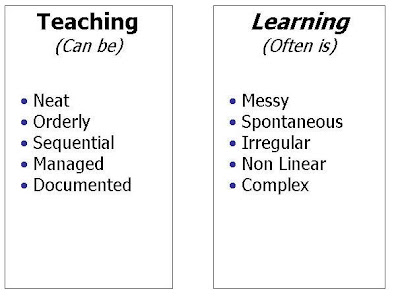
I’ve examined this as the struggle between being focused on teaching and being focused on learning.
The biggest change that has occurred in my work with coaching over the last 15 years is an increased focus on observing the learner vs the teacher and studying the teacher’s choices as they impact the learners’ choices.
Wolk has a great statement that captured the observation of the learner for me.

“Teaching through Inquiry considers our work a failure if students do not leave the school filled with questions and the yearning to explore them.” (pg 117)

I’d suggest that school administrators, coaches, and staff developers could voice a similar goal; we consider our work a failure if teachers do not leave our conferences, conversations, and workshops filled with questions and the yearning to explore them.

Wolk provides an inquiry process including, plan reflect, discuss, debate, ask more questions, make connections, and rethink inquiry. Wolk adds that having questions that guide inquiry is key, but behind the questions are “big ideas”. (pg 118)

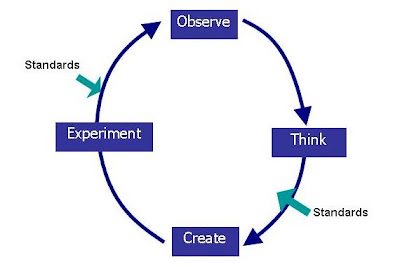
Again, Wolk’s comments fit for instructional leaders’ work with teachers. “Big Ideas” about teaching and learning should connect with coaching questions that promote teacher inquiry. Here is a diagram I use to illustrate teacher and coach inquiry conversation:


I suggest that the coach works from inside this circle, asking questions and providing input that increase a teacher’s observations (often the coach sees, hears, and feels, things not obvious to the teachers). Coaching questions and conversations increase teachers’ thinking (inquiry) that generate a desire to produce or create an idea. When teachers engage their students in a learning activity, they are experimenting, then identifying if the activity is producing the learning requires observation and thinking, which leads to the teacher’s next decision.

Wolk captures the importance of a culture of inquiry:
“The best teachers… live a life filled with learning, thinking, reading, and debating. Because inquiry is an important part of their lives, inquiry becomes an essential part of their classroom.” (pg 119)

As instructional leaders, we need to be “teaching” in ways that cause our staffs, our students, and ourselves to be living a culture of inquiry.