Learning in Communities

I was invited to observe in the video production class of Pat Phillips, an instructor at the Career and Technical Education School in Bismarck, North Dakota. During a pre-conference and observation with Pat, I was reminded of an earlier blog I had written on studio learning. Pat and his students work and learn as a community.

A sign on Pat’s wall caught my attention and started me thinking about learning communities.

My first reaction was to recall a somewhat similar message I had often seen in elementary classrooms, “Ask three before me.” (See video.) But as I considered the studio approach, I pondered a deeper, sophisticated message to the poster.

Taking a lead from the list, an internet search took me to a paper titled, Learning Communities in Classrooms: A Reconceptualization of Educational Practice, by Katerine Bielaczyc and Allan Collins. The authors suggested that the defining quality of a learning community is a culture of learning, in which everyone is involved in a collective effort of understanding.

They list four characteristics such a culture must have:

(1) diversity of expertise among its members, who are valued for their contributions and given support to develop
(2) a shared objective of continually advancing the collective knowledge and skills
(3) an emphasis on learning how to learn
(4) mechanisms for sharing what is learned.

Students learn to synthesize multiple perspectives, to solve problems in a variety of ways, and to use each other’s diverse knowledge and skills as resources to collaboratively solve problems and advance their understanding. The intent is for members to come to respect and value differences within the community. If a learning community is presented with a problem, then the learning community can bring its collective knowledge to bear on the problem. It is not necessary that each member assimilate everything that the community knows, but each should know who within the community has relevant expertise to address any problem.

Let’s revisit the four characteristics as they relate to teachers’ learning communities:

(1) diversity of expertise among its members, who are valued for their contributions and given support to develop. (Critical that teachers really know each other to appreciate the talent and knowledge within the community.)

(2) a shared objective of continually advancing the collective knowledge and skills (Setting shared learning outcomes for students can help a PLC keep this focus.)

(3) an emphasis on learning how to learn (This differentiates PLCs from the traditional work of grade level teams and departments.)

(4) mechanisms for sharing what is learned. (Peer coaching observations and sharing of classroom video clips can increase sharing of learning.)

In an effective PLC, teachers share a common mission of maximizing student learning. Each member has a responsibility to develop their own skills and understanding as well as that of each other. New knowledge should fly through the organization positively impacting all students.

Pat’s list for what to do when waiting for help can apply too for teachers in between PLC sessions. I see two keys: one is constantly sharing the opportunity for colleagues to join in building student success and the other keeping a continuous improvement mindset.



Motivation and Purposefulness

Recently, I was invited to work with grade level teams at an elementary school as a follow up to a day of walkthroughs at their school and presentations of my observations to the teachers. Our initial work had focused on engagement. I shared this in an earlier blog labeling engagement as teacher initiated and student initiated.

Here are the requests I received from some of the teams:

3rd Grade: We would like Mr. Barkley to help in the following ways: Motivation and the “uncaring” student. Describe some techniques to help students take ownership of their own learning. We are all confronting lack of motivation of some students within our classrooms and we have discussed this amongst our team and PLC’s. We strongly feel that these students negatively affect the classroom environment. Other students, who may not normally behave in this manner, tend to follow the “uncaring” students lead and do the same. The problem seems to spread. We have discussed motivation and tried many things that have had minimal impact. We would like Mr. Barkley to share some motivation techniques with us that have worked in other schools.

Kindergarten: We would like Steve to help us improve student effort and attempt. How do we make this student initiated instead of teacher initiated? What can we do to make our school FUN?? We want children to be excited about learning. Kindergarteners are excited about school but seem to lose that excitement as they grow older.

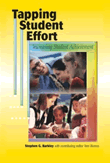
In both groups we spent some time reviewing work from Tapping Student Effort: Increasing Student Achievement. We reviewed the formula EFFORT times ABILITY focused on a MANAGEABLE TASK equals SUCCESS and looked at William Glasser’s work identifying survival, belonging, power freedom and fun as motivators.

I provided some examples from Tapping Student Effort for the third grade team:
Banana Split (page 108) where a third grade teacher created a class goal. When everyone in the class passes a test on the times tables, there would be a banana split party for the class. Her class quickly became a team helping and supporting each other to complete the task. To quote the teacher, ”They all experienced a degree of success due to their own hard work that led them to believe that memorizing the facts was possible for them.”

Skywalker Sprouts (page 62) where a second grade class from Michigan learns lots while running a business. Students purchase Alfalfa seeds, water and grow sprouts, package, market, sell and reinvest in the next crop. When problems arise they practice problem solving along with planning, and cooperating to reach a common goal. Students created a booklet for first time purchasers.

All these areas of motivation are connected to Daniel Pink’s work in DRIVE:The Surprising Truth About What Motivates Us.

“We know—if we have spent time with young children or remember ourselves at our best – we’re not destined to be passive and compliant. We’re designed to be active and engaged. And we know that the richest experiences in our lives aren’t when we are clamoring for validation from others, but when we’re listening to our own voice — doing something that matters, doing it well, and doing it in the service of a cause larger than ourselves.”(page 145)

Watch the primary students in this video having fun learning and identifying how they listen to their own voice and DO!

The first grade team asked to look at confidence in work and risk taking in reading tasks. After looking at the same information on motivation, I sent them to the blog of Silvia Rosenthal Tolisano to listen to first grade readers who blogged, podcast, and tweeted their updated Flat Stanley stories.

Listen to a few of the students reading on the podcast and you’ll note what Silvia states…reading and producing for a worldwide audience does make a difference.

I’d love to see your examples of students working with purposefulness. Promise I’ll share them with teachers to spark their thinking and push their courage to do the same.