Looking at Grading

The September 2013 issue of Educational Leadership, titled Resilience and Learning, has several thought provoking articles. Two of them connected with the work I am doing with a few districts examining grading, motivation, and engagement.

A Conversation with Angela Lee Duckworth (pages 14-20) explores the significance of grit (earlier blog).  She states that “grit and talent either aren’t related at all or are actually inversely related”.

Duckworth describes a study of taxi drivers; Rainy days can be a goldmine for taxi drivers as everyone wants a cab and fares are plentiful. So you would think that drivers who are earning more per hour on rainy days would work more hours… but they tend to work less hours on rainy days. It appears they have a fixed amount they need to earn per day in their heads and on rainy days they get there quicker and go home early.

She suggests it’s similar with grit and talent in academics. If students are just focused on getting an A, the really talented student gets there easily and works less hard. If you are trying to maximize your outcomes, there is no ceiling. Your goal is,” How can I get the most out of my day?”.

I met a high school English teacher who has students continually improve a piece of writing across the whole school year. Each month they get their work back with her comments on the strengths and how it can be improved. In May she returns the work with a grade. If the grade is an A, which in most cases it is, she also includes the date at which it was scored an A. Many students find that they improved their work, three or four times beyond an A. Exactly what the teacher wanted to communicate. “Don’t allow a grading system to set an arbitrary limit on what you are capable of achieving.”

In the same issue of Educational Leadership, Tom Guskey (earlier blog)  provides an article titled, The Case Against Percentage Grading. He identifies a 2011 study that replicated a 1912 study illustrating the inaccuracy of much that happens with grading:

90 High school teachers –who had received nearly 20 hours of training in a writing assessment program- were asked to grade the same student paper on a 100 point scale. Among the 73 teachers who responded, scores ranged from 50- 96.

Guskey raises these concerns

  •  If  60 or 65 is a passing score, a 100 point scale contains more distinct levels of failure than of passing. In affect students can receive a more finely distinguished degree of failure than of success.
  • In the absence of a truly accurate measuring device, adding more gradations to the measurement scale offers an illusion of precision. (I’d suggest that few of the assessments used in school are highly accurate measuring devices.)

This statement by Guskey in the closing of the article (page 72) identifies for me what must become the work of educators in Professional Learning Communities at all levels.

“Assigning fair and meaningful grades to students will continue to challenge educators at every level. The process requires thoughtful and informed professional judgment, an abiding concern for what best serves the interest of students and their families, and careful examination of the tasks students are asked to complete and the questions they are asked to answer to demonstrate their learning.”

School leaders and instructional coaches need to be engaging teacher teams in these conversations. I often find building or districts guidelines regarding “recording grades” pushing teachers’ decisions that are not “best serving the interest of students”. Designing assessment and grading practices that promote student achievement must be a continual teacher learning process.



Changing Role For Teachers: Modeled By Coaches

In the March 2013 Educational Leadership,Will Richardson asked the question,”What do we mean by learning?” (Students First, Not Stuff page 10).


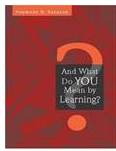
  Richardson quotes Seymour Sarason (2004 And what do YOU mean by learning?), “Productive learning is the learning process which engenders and reinforces wanting to learn more.” (p.x)
(See Richardson, author of Why School ,on video discussing productive learning.)


Richardson suggests that “wanting to know more” means a transfer of power over learning from teacher to student. It’s a shift from contrived to authentic creation and sharing of outcomes…from covering the curriculum to discovering it. These changes come with a change role in role of the teachers:

*Teachers must be co-learners with kids.
*Teachers need to be expert at asking great open-ended questions.
*Teachers should be master learners in the classrooms.
As I read this article it struck me that Richardson’s roles for the teacher creates a terrific guideline for instructional coaches and teacher and administrator leaders.
Co-Learners
An instructional coach can be described as a partner who learns alongside the teacher. I find it exciting that often when I share what I’m discovering with one teacher with another, a continuation of learning occurs for me and the teachers I’m connecting.  I currently am learning with teachers in North Dakota, Georgia, and Switzerland who are examining perseverance in elementary math classes. Each time I’ve shared with one group something the other found it is picked up, extended and then passed on. As a co-learner with each I’ve been able to extend a “wanting to learn more” environment.
Great open-ended questions
Questioning is a key coaching skill. I delight during a coaching conference when a question I ask a teacher gets the response, “That’s a great question”! Often as the teacher begins exploring an answer a new possibility for learning emerges for both of us. Recently I coached a Spanish teacher in Turkey using a video clip filmed with a still camera in back of the room. There were few clear observations I could make between not knowing the language and not being able to see the students’ faces. My post conference was built around questions which had the teacher recall perceptions during the instruction, compare them to the observations he made watching the video and examine with the expectations he had when planning the learning activities. A key question I asked was, “How would you place students’ engagement on a continuum from low to low- medium to medium to medium- high to high? How many would you place at each spot?” (Note: I had no assessment in my mind as to what it was.) The teacher’s reflection, with some probing from me, led to a picture in his mind of a next step he wanted to explore in teaching/learning. He developed another observation he wanted a colleague to conduct…“wanting to learn more”.

Model the learning process
I recently worked with a school introducing instructional coaching leadership positions in each area of student learning/curriculum. As teachers considered applying and administrators planned interviewing and selecting, I suggested that the ideal candidates would express their desire and excitement with what they would learn in these positions… exhibiting “wanting to learn more.”  When considering selecting people to serve in coaching and mentoring positions, I worry when interviewees stress “how much they know”.  My concern is that attitude leads to supervision over coaching. Cooperating teachers supporting university programs by opening their classrooms to interns can best support these future teachers by modeling how teachers learn. In my thinking, instructional coaches would be the most coached staff in a school.… Lead Learners!